
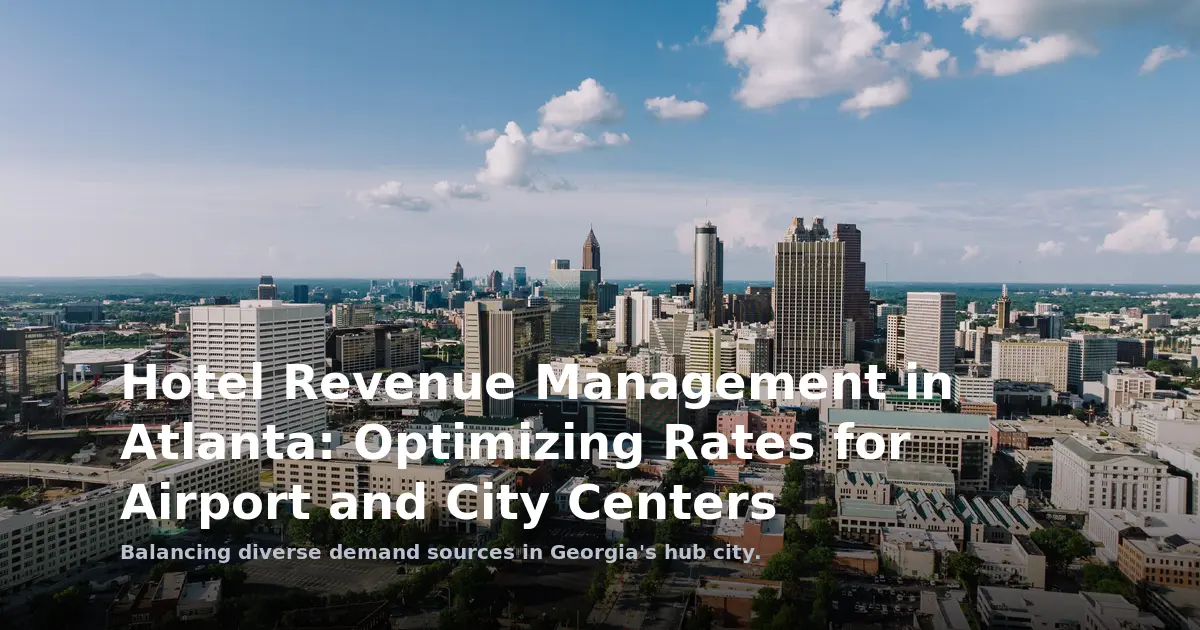
Atlanta is one of the most dynamic hospitality markets in the United States, characterized by a complex mix of transient airport traffic and high-demand urban centers. With exactly 185 hotels operating within the city, the competition for group bookings and individual traveler segments is intense. For hotel owners and managers, the challenge lies in balancing occupancy with Average Daily Rate (ADR) across diverse micro-markets, from the bustling corridors of Hartsfield-Jackson to the corporate hubs of Buckhead and Midtown.
Navigating the Atlanta Market Divide
Revenue management in Atlanta requires a bifurcated strategy. The city is essentially split between the "Airport Zone" and the "City Center/Urban Zone," each with distinct demand drivers and pricing sensitivities.
The Airport Transit Segment
Hotels located near the airport cater to a high volume of short-stay guests and corporate crews. Properties such as AC Hotel Atlanta Airport Gateway, Atlanta Airport Marriott Gateway, and Baymont Inn & Suites Atlanta Airport South operate in an environment where convenience and proximity are the primary value drivers. In this segment, revenue managers must be agile, adjusting rates based on flight schedules and seasonal travel surges. Because these properties often see a high volume of "last-minute" needs, the ability to respond quickly to requests is critical for capturing displaced revenue.
The Urban and Corporate Hubs
Conversely, properties in the city center, such as AC Hotel Atlanta Downtown, Canopy by Hilton Atlanta Midtown, and AC Hotel Atlanta Buckhead at Phipps Plaza, face different pressures. Demand here is driven by conventions, sporting events, and corporate headquarters. These hotels often see more significant fluctuations in group demand, requiring a strategy that prioritizes high-value RFPs over low-margin transient stays. When managing a property like Atlanta Marriott Suites Midtown or Comfort Inn, the goal is to optimize the mix of group and individual bookings to ensure maximum RevPAR (Revenue Per Available Room).
Optimizing Revenue through Strategic RFP Management
For the 185 hotels in Atlanta, the ability to control pricing without being locked into rigid commission structures is a significant competitive advantage. Traditional booking channels often strip away a percentage of the room rate, impacting the bottom line. A more effective approach is to utilize a direct-response system where the hotel maintains full control over its rates and availability.
By leveraging the HotelHuddle partner network, Atlanta hotels can gain exposure across five distinct consumer-facing brands. This multi-brand reach allows properties to cast a wider net, attracting a variety of traveler profiles—from budget-conscious groups to luxury corporate retreats—without sacrificing their margins. Best of all, signing up is completely free—no fees, no hidden costs, just direct access to high-intent booking requests.
The Power of the Counter-Offer
One of the most effective tools in revenue management is the ability to counter an RFP. In a volatile market like Atlanta, a request might come in at a rate lower than the current market value for a specific date. Instead of a binary "accept" or "decline," partners can use the responder tool at /rfp/{id}/responder to propose a rate that reflects current demand. This flexibility allows hotels to protect their ADR during peak events while still securing occupancy during shoulder seasons.
Streamlining the Booking Process
Efficient revenue management is not just about the price point; it is about the speed of conversion. In a city with 185 hotels, the guest or group organizer is often receiving multiple bids. The properties that win the business are typically those that respond the fastest with the most competitive, transparent offer.
The HotelHuddle partner portal simplifies this by providing a centralized dashboard at /rfp. This allows managers to view all incoming requests in one place, eliminating the need to monitor multiple email threads or third-party platforms. Because the onboarding process is self-service and instant, hotels can begin receiving requests immediately after registration.
For those unfamiliar with the process, the How It Works page provides a detailed breakdown of how the network connects hotels with high-intent travelers.
Maximizing Visibility and Revenue Growth
To grow revenue in the Atlanta market, hotels must diversify their lead sources. Relying on a single channel creates vulnerability. By integrating with the HotelHuddle partner network, hotels increase their visibility across five consumer brands, ensuring that their inventory is seen by a broader audience of group and individual travelers.
Crucially, this model allows hotels to keep their revenue. By removing per-booking commissions, the financial benefit of each booking stays with the property, allowing for better reinvestment into guest experiences and facility upgrades.
If you encounter any technical questions during the setup process, the Help Center is available to provide guidance on optimizing your profile and managing your requests.
Conclusion: Taking Control of Your Atlanta Inventory
Whether you are managing a luxury stay in Midtown or a high-efficiency airport hotel, the key to success in Atlanta is agility and control. By utilizing a platform that allows you to accept, counter, or decline requests based on real-time data, you can ensure your property remains profitable regardless of market shifts.
Sign up at partners.hotelhuddle.com and start receiving booking requests across 5 hotel brands. You can complete your instant onboarding via the Sign Up page to begin capturing more group and individual business today.