
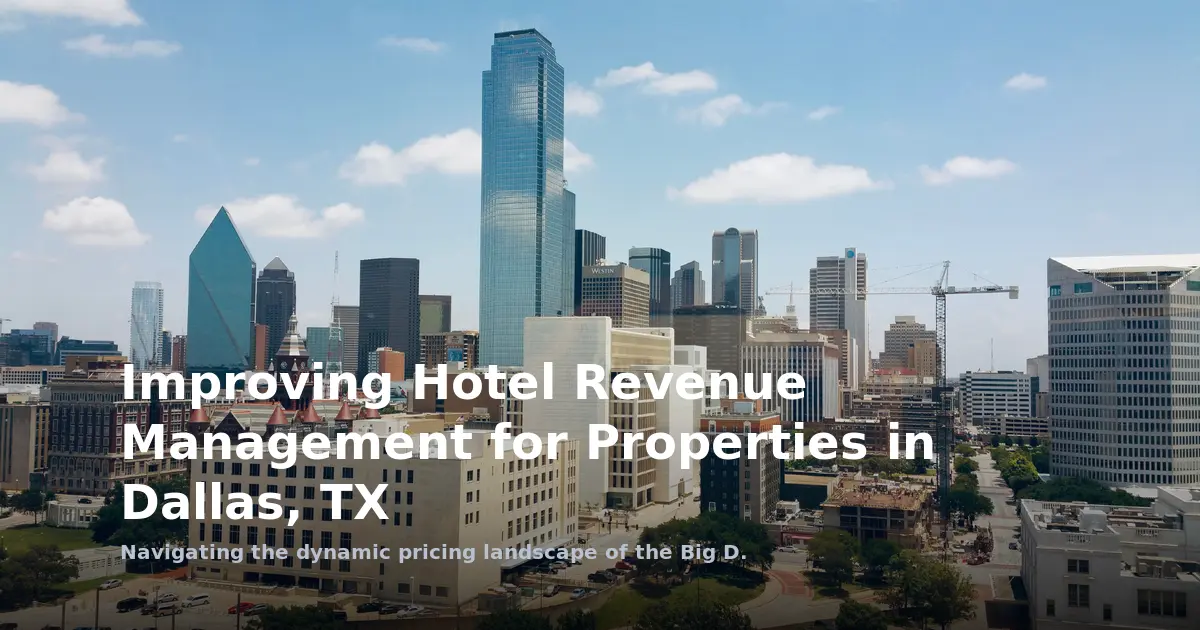
Revenue management in a competitive market like Dallas, Texas, requires more than just adjusting rates based on seasonality. For hotel owners and general managers in the "Big D," the challenge lies in balancing occupancy levels with the Average Daily Rate (ADR) while navigating a complex landscape of corporate travel, sporting events, and a growing leisure sector. To truly optimize the bottom line, properties must shift from reactive pricing to a proactive, data-driven strategy.
One of the most effective ways to increase hotel occupancy without triggering a "race to the bottom" in pricing is to diversify the sources of demand. Many properties in Dallas rely heavily on traditional Online Travel Agencies (OTAs), which often come with high commissions and limited control over the guest relationship. By leveraging a dedicated hotel partner portal, managers can access high-intent leads and group requests that are often overlooked by standard booking engines.
In the Dallas market, where the platform serves 8 hotels, the ability to respond quickly to specific Request for Proposals (RFPs) is a significant competitive advantage. For instance, properties like Aloft Dallas Downtown (Aloft Dallas Downtown) and Canopy by Hilton Dallas Uptown (Canopy by Hilton Dallas Uptown) operate in high-density areas where demand fluctuates rapidly based on downtown conventions and corporate headquarters. Implementing a robust hotel RFP management system allows these properties to evaluate the potential value of a group booking—considering not just the room rate, but the total guest spend and the ability to fill "gap nights" during low-demand periods.
Effective hotel revenue management also involves understanding the nuances of different hotel tiers. A boutique property or a focused-service hotel like Ari Motel (Ari Motel) or Budget Suites of America (Budget Suites of America) faces different pressures than a large-scale convention hotel. For these smaller properties, maximizing the yield per available room is critical. Utilizing a hotel partnership that connects properties directly to group organizers and corporate planners allows them to secure base occupancy early, providing the financial stability needed to optimize pricing for the remaining inventory.
Moreover, the integration of real-time demand signals is essential. Whether it is a massive event at the AT&T Stadium or a corporate takeover in the Uptown district, the speed at which a manager can adjust their strategy often determines the success of the quarter. Properties such as (Aloft Dallas Love Field) and Baymont Inn & Suites Dallas Love Field (Baymont Inn & Suites Dallas Love Field) are uniquely positioned to capture transient traffic and short-term corporate stays. By streamlining the hotel onboarding process onto professional distribution networks, these hotels can ensure they are visible to the right planners at the right time.
For those looking to refine their hotel group sales strategy, it is important to remember that the value of a group booking extends beyond the initial stay. A well-managed group request can lead to recurring annual business. By using a platform that allows hotels to accept and counter RFPs efficiently, managers can spend less time on manual data entry and more time on strategic pricing.
To remain competitive in Dallas, hotel operators should focus on three core pillars: demand diversification, rapid response times, and precision pricing. Moving away from static rate sheets and toward a dynamic model where bids are competitive and tailored to the specific needs of the requester is the only way to ensure long-term growth.
If you are ready to expand your reach and optimize your property's visibility to high-value group planners, it is time to list your hotel on a network designed for professional growth.
Start growing your revenue today by visiting the HotelHuddle Partner Registration page to join the network.